
Master plan at a glance
| Land area | ~25 acres |
| Towers | ~31 residential towers |
| Floors | G+15 |
| Total units | ~1,961 apartments |
| Configuration mix | 2 BHK Luxe, 3 BHK Premium, 3 BHK Luxe |
| Built-up coverage | Minority of site (low-coverage plan) |
| Open / landscaped space | Majority of site |
| Clubhouse | Central grand clubhouse precinct |
| Delivery | Phased, amenities front-loaded |
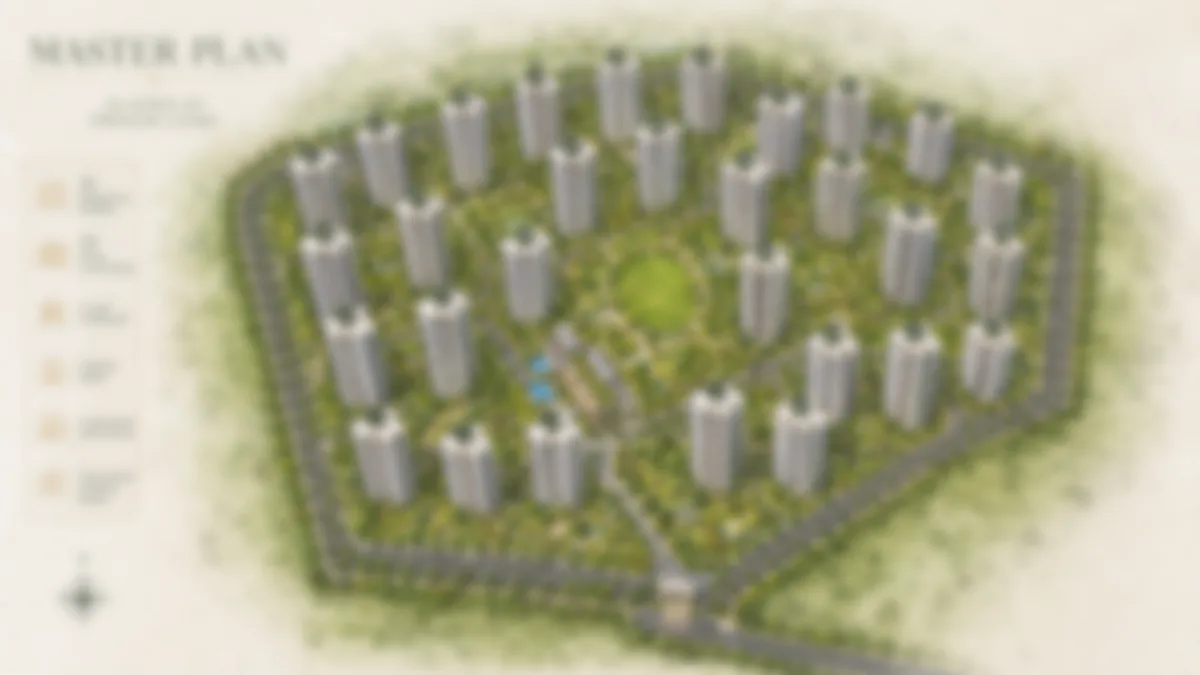
The core planning idea - scale without density
The defining decision in the Sattva KIADB master plan is the trade-off between height and spread. The project carries a large unit count - ~1,961 apartments - but distributes it across roughly 31 towers at a modest G+15 height rather than concentrating it in a handful of 30-plus-storey high-rises. This is the inverse of the dominant pattern on the corridor, where competing projects stack similar unit counts into far taller towers. From a planning angle, Sattva Lumina keeps the reference local: internal roads, open-space placement, amenity access, and tower orientation all affect how the address will live after handover.
The consequences of the low-and-wide approach are felt at the resident level every day:
- Lower per-tower density. Fewer households share each lobby, each lift bank, and each floor plate. The morning lift queue is shorter; the corridors are quieter; the sense of a manageable, knowable community is stronger.
- Faster vertical circulation. A G+15 tower reaches the top floor in a fraction of the time a 30-storey tower takes, and lift maintenance and replacement costs over the building's life are lower.
- A softer skyline and better light. Mid-rise towers spread across a large parcel let more daylight reach the ground plane and the lower floors, and avoid the canyon effect of clustered high-rises.
- More ground-level community. Spreading the towers leaves the majority of the 25 acres for the landscape, the clubhouse precinct, and the sports zones - the shared spaces where a community actually forms.
Zoning the site
The master plan organises the ~25 acres into four functional zones.
1. The Residential Towers
The ~31 G+15 towers are distributed across the parcel to maximise spacing between buildings, preserve sightlines, and ensure cross-ventilation and daylight for the maximum number of units. Tower placement prioritises north-south orientation where the parcel geometry allows, which is the preferred orientation for Bengaluru's climate. Each tower is served by its own lift core and lobby, with the unit mix - 2 BHK Luxe, 3 BHK Premium, 3 BHK Luxe - distributed to give buyers a choice of configuration across multiple towers and phases.
2. The Central Greens and Landscape
The majority of the site is open and landscaped. The central green is the project's signature open space - a large, programmed landscape that connects the towers to the clubhouse and the sports zones via pedestrian pathways. The landscape is layered: formal lawns and gardens, informal groves, water features, jogging and walking loops, cycling tracks, reflexology pathways, children's play zones, senior citizens' courts, and a pet park. The intent is a landscape that is used at every hour of the day by every demographic in the community.
3. The Clubhouse Precinct
A grand central clubhouse anchors the community's social life. Positioning the clubhouse centrally - rather than tucking amenity floors inside individual towers - isolates noise and activity from apartment owners and gives the amenities meaningful, programmable space. The clubhouse precinct houses the indoor amenities (gymnasium, indoor games, multipurpose halls, wellness and co-working spaces) and connects directly to the outdoor amenity zones - the swimming pool, the pool deck, and the sports courts.
4. The Sports and Activity Zones
A dedicated sports-and-activity belt carries the courts and active-recreation amenities: swimming pool and kids' pool, badminton, basketball, tennis, cricket practice nets, a multipurpose play field, skating, and an amphitheatre / open-air event space. Clustering the active amenities keeps the noise and activity zoned away from the quieter residential and landscape areas.
Circulation - separating people from cars
The master plan separates pedestrian movement from vehicular movement. Vehicle entry routes to a perimeter and basement-parking network, keeping the internal community zones - the central green, the clubhouse precinct, the sports belt, and the children's areas - largely pedestrian. Residents can walk from any tower to the clubhouse, the pool, and the play areas without crossing a driveway. This vehicular-separation principle is standard in well-planned large-format communities and is a meaningful safety and liveability advantage for families with children and elderly residents.
A single-gateway entry with 24x7 CCTV surveillance and visitor management controls access to the entire community - a security model that scales efficiently across a large, gated parcel.
Open space and sustainability
The low-coverage layout is the foundation of the project's open-space ratio - the majority of the 25 acres is landscape, amenity, and circulation rather than building footprint. Layered on top is a sustainability infrastructure consistent with Sattva's portfolio standards: rainwater harvesting to recharge the water table and reduce dependence on external supply, a sewage treatment plant that recycles wastewater for landscape irrigation, energy-efficient common-area lighting and systems, and a landscape strategy that preserves and adds tree cover. For a community of nearly 2,000 households, this infrastructure is not a marketing line - it is the operational backbone that keeps long-run maintenance costs predictable and the campus environment healthy. The amenities page details the full programme.
Phased delivery
A ~31-tower, ~1,961-unit community is delivered in phases. The Sattva KIADB master plan sequences construction so that the clubhouse and core amenities are front-loaded - early residents inherit a functioning community with the pool, the gym, and the central landscape operational, rather than a construction site with amenities promised for a distant future phase. Phasing also lets the developer match supply to absorption, which supports orderly pricing across the project's launch-to-handover cycle. Possession is expected from 2030 onwards, sequenced across the phases.
Tower orientation and daylight
Orientation is one of the quietest but most consequential master-plan decisions. In Bengaluru's climate, north-south-oriented towers - where the long facades and primary balconies face north and south - receive even, indirect daylight and avoid the harsh, heat-loading east-west sun on the main living spaces. The Sattva KIADB master plan prioritises favourable orientation where the parcel geometry allows, distributing the ~31 towers to maximise the number of units with good light and cross-ventilation. The low-and-wide layout helps here too: spreading the towers reduces the mutual shadowing that clustered high-rises impose on each other's lower floors, so more apartments across the community receive genuine daylight rather than borrowed light from a narrow gap between towers.
Parking and services infrastructure
A ~1,961-unit community generates a large parking and services load, and the master plan resolves it below and around the residential zones rather than through the community's heart. Vehicle parking is handled through a basement and perimeter network, keeping the central greens, the clubhouse precinct, and the children's areas free of moving cars. The services infrastructure - the sewage treatment plant, the water-treatment and rainwater-harvesting systems, the power-backup and electrical infrastructure, the solid-waste management - is zoned to the periphery and the basements, away from the residential and amenity cores. This back-of-house planning is invisible in the brochure render but defines the day-to-day quality of a large community: well-zoned services mean less noise, less smell, and fewer operational intrusions into the lived environment.
The open-space ratio in practice
A high open-space ratio is a standard marketing claim, so the meaningful question is how the open space is programmed. At Sattva KIADB, the majority of the parcel that is not building footprint is not undifferentiated leftover land - it is an actively-designed landscape: formal gardens and lawns, a central green that anchors the community, jogging and walking loops, cycling tracks, reflexology pathways, children's and toddler zones, senior citizens' courts, and a pet park, all stitched together by the pedestrian network. The test of a master plan's open space is whether it is used at every hour by every demographic, and the Sattva KIADB landscape is programmed to that standard. When evaluating the master plan at the sales office, ask not just for the open-space percentage but for the landscape plan that shows how each zone is programmed.
Comparing the master plan to the corridor
The corridor's competing projects make different master-plan bets. Some - Purva Northern Lights at B+G+31, for example - stack a similar or larger unit count into fewer, much taller towers, which frees more ground for landscape but concentrates density vertically and lengthens lift travel. Sattva KIADB's G+15, ~31-tower bet spreads the density horizontally, trading some ground-level openness for lower per-tower density, faster vertical circulation, and a more human community scale. Neither approach is universally right - the high-rise bet maximises views and ground-level openness, the mid-rise bet maximises liveability and circulation efficiency. For a family buyer who values a knowable, walkable, low-queue community, the mid-rise master plan is the stronger fit, and that is the buyer Sattva KIADB is designed for.
The master plan is where a large project either succeeds or fails as a place to live. Sattva KIADB's plan makes three buyer-relevant choices well: it trades height for spread to keep the community liveable at scale; it centralises the clubhouse and zones the amenities to balance activity against quiet; and it separates pedestrians from vehicles to make the internal environment safe and walkable. For a buyer choosing between corridor projects, the master plan is the differentiator that the brochure render does not always reveal - and it is worth walking the site plan in detail during a sales visit before committing.
Sattva KIADB Master Plan FAQs
What is the core planning idea behind the Sattva KIADB master plan?
The defining decision is to trade height for spread: the project carries a large unit count of ~1,961 apartments but distributes it across roughly 31 towers at a modest G+15 height rather than concentrating it in a handful of 30-plus-storey high-rises. This delivers lower per-tower density, faster vertical circulation, a softer skyline and better light, and more ground-level community space.
How is the Sattva KIADB site zoned?
The ~25 acres are organised into four functional zones: the residential towers, the central greens and landscape, the clubhouse precinct, and the sports and activity zones. The clubhouse is centralised, the active amenities are clustered into a sports belt, and the passive amenities are woven through the landscape.
How does the master plan handle circulation and parking?
The plan separates pedestrian movement from vehicular movement. Vehicles route to a perimeter and basement-parking network, keeping the central green, the clubhouse precinct, the sports belt, and the children's areas largely pedestrian. A single-gateway entry with 24x7 CCTV and visitor management controls access across the gated parcel.
Is Sattva KIADB delivered in phases?
Yes. The master plan sequences construction so that the clubhouse and core amenities are front-loaded - early residents inherit a functioning community with the pool, the gym, and the central landscape operational, rather than a construction site with amenities promised for a distant phase. Possession is expected from 2030 onwards.
What sustainability infrastructure is built into the master plan?
Rainwater harvesting to recharge the water table, a sewage treatment plant that recycles wastewater for landscape irrigation, energy-efficient common-area lighting and systems, and a landscape strategy that preserves and adds tree cover - consistent with Sattva's portfolio standards.